Outdoor LED Screen for Advertising, Façades and Events
An outdoor screen has to survive sun, rain and distance. EKINTRY builds weatherproof, high-brightness outdoor LED to your size and quotes it factory-direct.
From US$100 — final price depends on your size, pixel pitch and finish. Contact us for an exact quote.
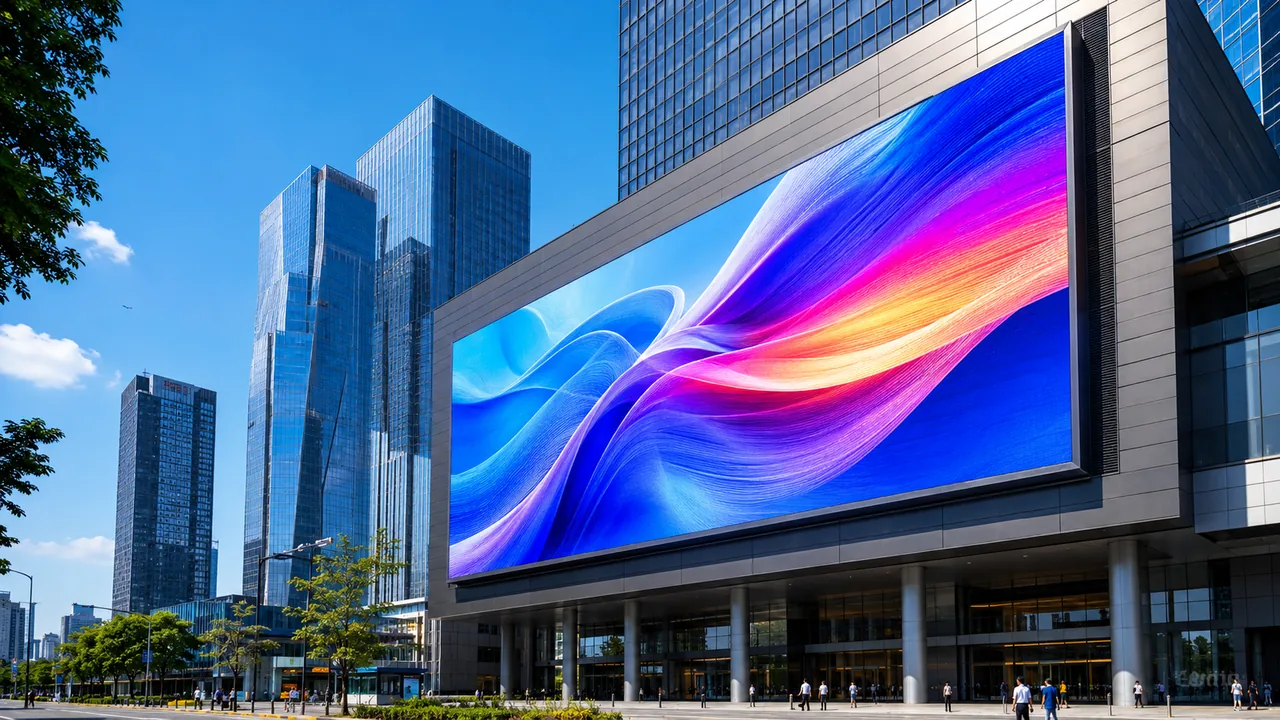
An outdoor LED screen is engineered for two things an indoor screen is not built for: daylight and weather. It runs far brighter to stay readable against the sun, and it is sealed against dust and rain so it keeps working outdoors for years.
This page explains what makes a screen genuinely "outdoor" — brightness, IP rating, pixel pitch and cabinet build — so you can specify the right one. EKINTRY manufactures outdoor LED to your size and location: P3.91 IP65 4,500-nit from $1,200–$1,800/m², P6–P8 billboard from $550–$850/m², factory-direct and shipped worldwide.
Who custom screens are for
- Outdoor advertising, billboards and roadside media.
- Building façades, rooftops and entrances.
- Stadiums, events and perimeter displays.
- Petrol stations, car dealerships and drive-thrus.
What makes a screen truly "outdoor"
Three things separate an outdoor screen from an indoor one moved outside. Get any of them wrong and the screen either disappears in daylight or fails in the first storm.
- Brightness — 5,000–8,000 nits so content stays vivid in direct sun (indoor screens are ~600–1,500 nits and wash out).
- Weatherproofing — at least IP65: the "6" means fully dust-tight, the "5" means it withstands water jets from any direction.
- Cabinet — die-cast aluminium with sealing and cooling, not an open indoor frame.
Best for — and when it is the wrong choice
Outdoor LED is the right call wherever the screen faces the open air or strong daylight. It is over-specified (and over-priced) for the wrong places.
- Right for: façades, billboards, stadiums, forecourts, outdoor events.
- Not ideal for: an indoor lobby or meeting room — a fine-pitch indoor screen is cheaper and sharper there.
- For a glass shop window, use a window/storefront build tuned for behind-glass viewing rather than a full outdoor billboard screen.
Pixel pitch by viewing distance
Outdoor viewers stand further back, so a coarser pitch is usually correct — paying for a fine pitch nobody can resolve just wastes budget. Match pitch to the closest viewer:
- Close range (≤6 m) — P4–P5 for sharp, near-view content.
- Medium range (6–10 m) — P6 balances clarity and cost.
- Long range (>10 m) — P8–P10 for billboards and stadium perimeters.
Lifespan and running cost
Quality outdoor LED is rated for 100,000+ hours — over a decade of heavy use — and is serviced at module level, so a single failed module is replaced without removing the wall. Power draw and brightness scheduling matter for running cost, which we factor into the recommendation.
How outdoor LED is priced
Outdoor screens cost more per square metre than indoor because of the brightness, IP-rated sealing and structure. Price is driven mainly by pixel pitch (finer = more LEDs = more cost), size, brightness and mounting. We quote per square metre from your spec — no fixed list price.
Common mistakes to avoid
The mistakes we see most often add cost or kill the result:
- Under-specifying brightness — a "bright" indoor panel still washes out in real sunlight; insist on 5,000+ nits.
- Buying too fine a pitch for a far-away audience — wasted money with no visible gain.
- Ignoring IP rating or using indoor cabinets outdoors — leads to early failure.
- Forgetting structure and access — wind load, mounting and service access must be planned with the screen.
| Brightness | 5,000 – 8,000 nits |
|---|---|
| Protection | IP65+ (dust-tight, water-jet resistant) |
| Pixel pitch | P4–P5 close · P6 medium · P8–P10 long range |
| Cabinet | Die-cast aluminium, sealed & cooled |
| Lifespan | 100,000+ hours |
Send us your project details
To recommend the right screen size, pixel pitch, cabinet type and shipping, please send us:
- Approximate size or area to cover.
- Closest and furthest viewer distance.
- Mounting (wall, freestanding, rooftop) and location.
- Any brightness or content requirement.
- Delivery country, plus a photo of the site if possible.
Frequently Asked Questions
How bright does an outdoor LED screen need to be?
Around 5,000–8,000 nits to stay readable in direct sunlight. Ordinary indoor screens (~600–1,500 nits) wash out outdoors.
What IP rating should an outdoor screen have?
At least IP65 — fully dust-tight and resistant to water jets — which covers the large majority of outdoor installations including rain and hose-down cleaning.
What pixel pitch is best outdoors?
It depends on viewing distance: P4–P5 for ≤6 m, P6 for 6–10 m, and P8–P10 for billboards and long-distance viewing. A coarser pitch is fine far away and costs less.
How long does an outdoor LED screen last?
Quality screens are rated for 100,000+ hours — typically 10–15 years depending on daily use — with module-level servicing to extend life.
Why is outdoor more expensive than indoor?
Higher brightness, IP-rated weatherproofing, stronger cabinets and mounting all add cost compared with an indoor screen of the same pitch.
Can you build any size?
Yes — outdoor screens are modular, so we build to your dimensions and recommend the structure and mounting.
How much does an outdoor LED screen cost per m²?
P3.91 IP65 4,500-nit outdoor screens start from $1,200–$1,800/m² factory-direct. P6–P8 billboard screens from $550–$850/m². Send your width, height and location for an exact quote.
How do I get a price for an outdoor LED screen?
Send the display width × height, where it mounts (façade, ground or billboard) and the nearest viewing distance. We quote within 24 hours — per m² with a pixel pitch recommendation.