Indoor LED Screen: Fine-Pitch Displays Built to Size
Indoors, sharpness matters more than brightness. EKINTRY builds fine-pitch indoor LED to your size and recommends the right pitch for how close people sit — factory-direct.
From US$100 — final price depends on your size, pixel pitch and finish. Contact us for an exact quote.
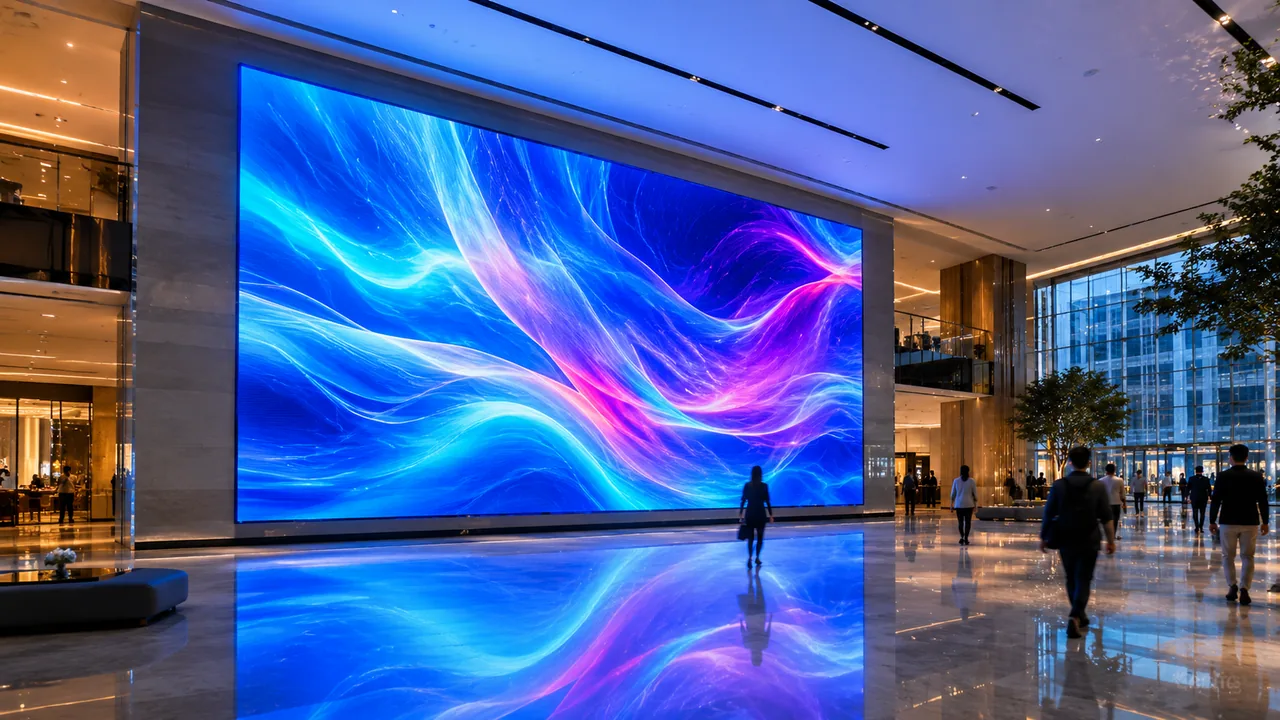
An indoor LED screen is viewed up close, so the priority flips from brightness (the outdoor concern) to resolution: the pixels must be fine enough that text and images look smooth from where people actually stand. That is set by pixel pitch.
This page explains fine-pitch vs standard-pitch indoor LED, which pitch suits which distance, and where each is the right choice. EKINTRY builds indoor LED to your size — P3.91 from $400/m², P2.5 fine-pitch from $650/m² — factory-direct, shipped worldwide.
Who custom screens are for
- Corporate lobbies, reception walls and control rooms.
- Retail interiors and brand feature walls.
- Conference rooms, broadcast studios and command centres.
- Hotels, museums and exhibition spaces.
Fine pitch vs standard pitch
Indoor LED is grouped by pixel pitch — the gap in millimetres between LEDs. The finer the pitch, the more LEDs per square metre, the sharper the image up close, and the higher the cost.
- Ultra-fine (≤1.5 mm) — near-print sharpness for broadcast, control rooms and premium retail.
- Standard fine (2.0–3.0 mm) — the sweet spot for lobbies, conference rooms and retail viewed at 10–20 ft.
- Above ~3 mm — economical for larger rooms where viewers sit further back.
Best for — and when it is the wrong choice
Indoor LED shines wherever people view content at close-to-medium distance in a controlled-light space. It is the wrong tool in a couple of cases:
- Right for: lobbies, control rooms, conference rooms, retail interiors, studios.
- Not ideal for: a sun-facing window or outdoor wall — use a high-brightness window or outdoor build instead.
- Over-kill: ultra-fine pitch for a room where everyone sits 8+ m back — a standard pitch looks identical and costs far less.
Choosing the right pixel pitch
Match pitch to the closest comfortable viewing distance:
- Close viewing (< 2.5 m) — P0.9–P1.5.
- Medium (2.5–5 m) — P1.8–P2.5.
- Larger rooms (5 m+) — P3 and above.
- Content matters too: fine text and data need a finer pitch than motion video.
Brightness, install and maintenance
Indoor LED runs around 600–1,500 nits — bright enough for interiors without glare — with adjustable brightness for changing light. Cabinets are slim with front or rear service so a faulty module is swapped without dismantling the wall.
How indoor LED is priced
Pixel pitch is the biggest driver: a P1.5 screen packs far more LEDs per square metre than P3, so it costs more for the same size. Size, brightness and the control system follow. We quote per square metre from your spec rather than a fixed list price.
Common mistakes to avoid
Most regrets come from one of these:
- Paying for ultra-fine pitch nobody can resolve at the real viewing distance.
- Choosing too coarse a pitch for a close-up wall, so text looks blocky.
- Buying an indoor screen for a window or outdoor spot, then finding it washes out.
- Ignoring content type — detailed dashboards need finer pitch than video.
| Pixel pitch | P0.9 – P3+ by viewing distance |
|---|---|
| Brightness | 600 – 1,500 nits (adjustable) |
| Best for | Lobbies, control rooms, retail, conference |
| Service | Front/rear, module-level |
Send us your project details
To recommend the right screen size, pixel pitch, cabinet type and shipping, please send us:
- Room or wall size (or area to cover).
- Closest comfortable viewing distance.
- Content type — text/data or video.
- Application (lobby, control room, retail, studio).
- Delivery country.
Frequently Asked Questions
What pixel pitch do I need for an indoor LED screen?
Match it to viewing distance: P0.9–P1.5 under 2.5 m, P1.8–P2.5 for 2.5–5 m, and P3+ for larger rooms. Our pixel pitch calculator can help.
What is a fine-pitch LED display?
One with a pixel pitch roughly 0.7–2.9 mm. Ultra-fine (≤1.5 mm) gives near-print sharpness for control rooms and premium retail; standard fine (2.0–3.0 mm) suits most indoor uses.
How bright should an indoor LED screen be?
Around 600–1,500 nits, with adjustable brightness — bright enough for interiors without causing glare.
Is indoor LED cheaper than outdoor?
For the same pixel pitch, usually yes — indoor screens do not need the high brightness, IP sealing and heavy cabinets that outdoor screens require.
Can an indoor screen go near a window?
Only away from direct sun. For a glass shop window facing the street, use a high-brightness window/storefront build instead.
Can you build a custom size?
Yes — indoor LED is modular, so we build to your exact wall and recommend the pitch.
How much does an indoor LED screen cost?
Indoor fine-pitch LED starts from $400/m² for P3.91 and from $650/m² for P2.5, factory-direct. Price varies with pixel pitch, total area and cabinet type — send wall dimensions and viewing distance for a quote.
What is the minimum size for an indoor LED screen?
Modular cabinets can build from a small panel upwards — common installs start around 1.5m × 1m. Tell us the wall space and we recommend the practical minimum that looks right in your room.