Custom Size LED Screen Cost: How Size Drives the Price
A custom size is normal for LED — but how you size it changes the cost. This page explains the cabinet maths so you get the size you want without paying for waste.
From US$100 — final price depends on your size, pixel pitch and finish. Contact us for an exact quote.
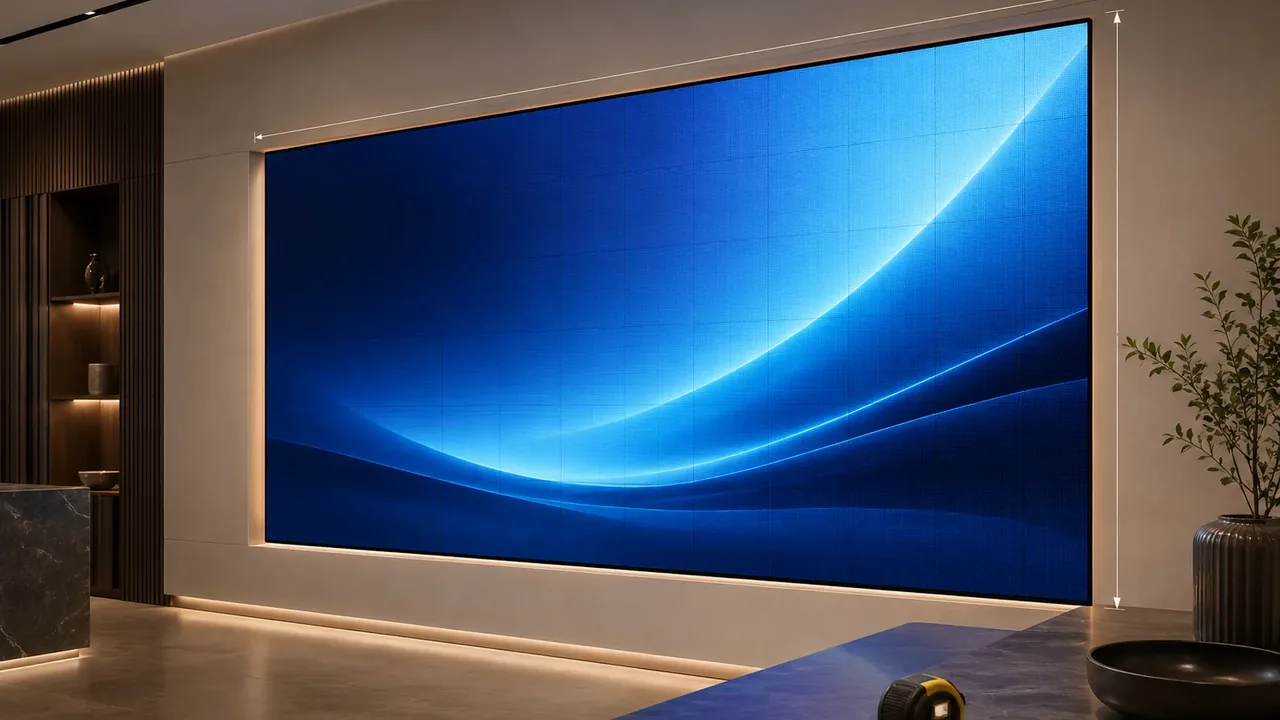
Because LED screens are built from modular cabinets, "custom size" is the normal case, not a premium special order. But the exact width and height you choose interact with the cabinet grid — and that, plus total area, is what really drives the cost of a custom-size screen.
This page explains how size affects price: the cabinet maths, why some target sizes are more economical than others, and how scale changes the per-square-metre rate. EKINTRY sizes it to your space and quotes factory-direct.
Who custom screens are for
- Buyers who need a specific, non-standard size.
- Anyone fitting a screen to an exact wall or alcove.
- Designers specifying an aspect ratio.
- Budget owners weighing size vs cost.
Cabinets set the size — and the cost
A screen is a grid of standard cabinets (for example 500×500 mm or 960×960 mm). Your size is built by tiling whole cabinets to the nearest fit. Costs are driven by how many cabinets that takes, so the practical lever is choosing a target size that lands close to a whole number of cabinets rather than mid-cabinet.
Why exact custom sizes can cost a little more
If your target lands part-way across a cabinet, we round to the nearest buildable size — slightly larger or smaller. Forcing a truly bespoke odd size can mean custom cabinets and more cost. Sharing your target and tolerance lets us hit it economically.
Scale: bigger is cheaper per m²
Total cost rises with area, but the per-square-metre rate usually falls on larger orders thanks to bulk efficiency — so a bigger screen is not linearly more expensive. Small screens carry more fixed cost (controller, packing) per square metre.
Aspect ratio and content
Non-standard ratios (ultra-wide, square, vertical) are fine, but plan your content for the shape so you do not pay for pixels that sit unused behind letterboxing. We advise a ratio that fits both the wall and the content.
Common mistakes to avoid
Sizing pitfalls that cost money:
- Specifying an exact odd size when rounding to whole cabinets would be far cheaper.
- Ordering a tiny screen where fixed costs dominate the per-m² rate.
- Choosing a ratio the content does not fill, wasting pixels.
- Ignoring the cabinet grid, then being surprised by the buildable size.
| Built from | Standard cabinets (e.g. 500/960 mm) |
|---|---|
| Main driver | Number of cabinets (≈ total area) |
| Scale effect | Larger orders → lower per-m² rate |
| Best practice | Target a near-whole-cabinet size |
Send us your project details
To recommend the right screen size, pixel pitch, cabinet type and shipping, please send us:
- Target width and height (plus any tolerance).
- Indoor or outdoor, and pixel pitch.
- Aspect ratio / content shape.
- Mounting and location.
- Delivery country.
Frequently Asked Questions
Does a custom size cost extra?
Usually not — custom size is normal for modular LED. Cost tracks the number of cabinets (total area), so a size near a whole number of cabinets is most economical.
Can you build my exact dimensions?
We build to the nearest buildable cabinet size — typically within a cabinet of your target. Truly bespoke odd sizes can use custom cabinets at extra cost; tell us your tolerance.
Is a bigger screen more expensive per square metre?
No — larger orders usually lower the per-m² rate through bulk efficiency, while small screens carry more fixed cost per square metre.
Can I have an unusual aspect ratio?
Yes — ultra-wide, vertical or square are all possible. Plan your content for the shape so you do not pay for unused pixels.
What size is most cost-effective?
One that lands close to a whole number of standard cabinets at the pitch you need. We suggest the nearest economical size to your target.
How do I get a quote?
Send your target size, pitch, indoor/outdoor and delivery country; we return the nearest buildable size and a factory-direct price.